AMD Stream board
The awards for role-playing games (RPG's)
ATI Radeon X1650 to the next level x1650 XT
Adult Gaming - Driven By ThriXXX and Jenna Jameson
GeCube Ati Radeon X1650Pro Platinum - Graphics and...
GeCube Ati Radeon X1650Pro Platinum - Graphics and...
ATI launches x1950Pro
Nvidia launches new mobile graphics performance champ
NVIDIA has unveiled their new GeForce Go 7950 GTX ...
Today we will be taking an in-depth look into two of those "new" products, as both use parts handed down from existing current generation products.
Take the Nvidia GeForce 7900GS, for example. This recently released graphics card is based on the original G71 architecture, which made its debut past March in the form of the GeForce 7900GTX. The 7900GT was the second graphics card to be built around the G71 core, followed by the 7950GT, and now the 7900GS. The 7950GT is nothing more than a supped up version of the 7900GT, though the added performance of the new 7950GT does justify the added cost. The 7900GS, on the other hand, might still be based on the same architecture, but it is a more unique product created to fill the void between the 7950GT and the 7600GT.
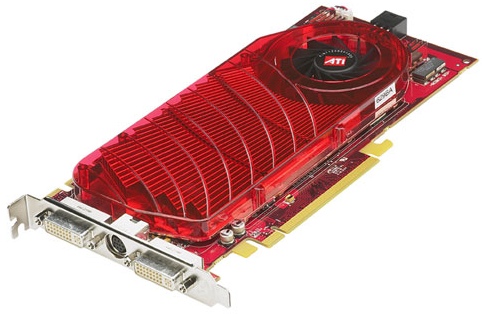
With a sub-$200 price tag, the GeForce 7900GS has indeed made a great job filling the gap, in fact, prior to the release of the competing Radeon X1950 Pro, there was nothing that could really compete with it in this price range. Therefore in an effort to regain some prime real-estate back, ATI gave life to this new Radeon family member.
Like the 7900GS, the X1950 Pro appears to be a brand new product, and it even goes by a new code-name “RV570”, but do not let this fool you. The specifications of the X1950 Pro are suspiciously close to that of the X1900GT, which was a failure in my eyes. Perhaps that's a little harsh comment regarding the Radeon X1900GT, however at the time of its release the product was slower than existing X1800XT and 7900GT products, yet it was significantly more expensive. For that reason I wrote the X1900GT off early, and it never really came back to redeem itself, until now of course. The new X1950 Pro features the same core clock frequency as the X1900GT, faster memory (180MHz higher) and the same amount of rendering pipelines. However, while the X1900GT made its debut at $300, the X1950 Pro will be available at the much more affordable price of $200. Although on paper the specifications of the X1950 Pro and 7900GS seem to be quite different, there are a few similarities we can talk about. For starters, both products come armed with 256MB GDDR3 memory, though the X1950 Pro has a 60MHz clock advantage here. As usual, the ATI card also carries the higher core clock frequency (125MHz advantage). However, where the X1950 Pro loses is in the amount of physical pipelines as it features just 12, whereas the 7900GS sports a total of 20. Both graphics cards feature a single texture mapping unit, and the X1950 Pro utilizes an additional vertex processing unit. Once all that has been taken into account, the X1950 Pro ends up with just 2GB/s more memory bandwidth on its favor (a ~5% advantage).
Perhaps, the biggest strength of the GeForce 7900GS is its overclocking ability. Manufacturers are already shipping 7900GS cards with a 30% rise in core frequencies and up to 10% boost in memory speeds. In many cases I found this to result in performance increases that went anywhere from 15% and up to 30%. Given the 7900GS already delivers exceptionally good value for a sub-$200 graphics card, a potential performance increase of 30% is very impressive.
This is where I believe the war between the GeForce 7900GS and the Radeon X1950 Pro will be settled. Depending on the games used for comparison, the performance can go either way as we have seen time and time again. This means that unless the Radeon X1950 Pro is able to achieve a reasonable boost in performance through overclocking, it might fall short, or will it?
Benchmarks: 3Dmark2006, X3: Reunion
- Intel Core 2 Duo E6700 (2.66GHz) LGA775
- ATI Radeon X1950 Pro (256MB)
- Microsoft Windows XP Pro (SP2)
- Nvidia Forceware 91.47
- ATI Catalyst 6.10
- Intel System Drivers 7.2.2


Previous tests using X3: Reunion have shown that this engine tends to favor ATI-based graphics cards. That being the case I was not surprised to find the Radeon X1950 Pro defeating the GeForce 7900GS. However, I was surprised about the degree to which the X1950 Pro defeated the 7900GS, at 1600x1200 the Radeon was 40% more powerful. The X1950 Pro once again failed to gain much ground through overclocking, and as a result the 7900GS was able to close the margin down to 22%.
Benchmarks: Far Cry, F.E.A.R

 The Radeon X1950 Pro also does very well in Far Cry as it defeated the GeForce 7900GS by 40% prior to overclocking. Once the cards were overclocked this margin was reduced to 24%, which is still obviously a very significant win for the X1950 Pro.

 F.E.A.R is a very demanding game, and when FSAA 4x + Aniso 16x quality settings are enabled, good frame rates are hard to come by. That being the case we will go off the 1024x768 performance where the Radeon X1950 Pro was 45% faster than the GeForce 7900GS. Once again overclocking did reduce the performance margin to 26% in favor of the Radeon, still a very strong lead.
And the best buy is: The overclocked GeForce 7900GS configuration did its best to hang in there, and at the lowest tested resolution of 1024x768 it did quite well against the X1950 Pro. As the resolution was increased, so did the performance gap, and by the time we hit 1600x1200 the X1950 Pro was leading the pack. Just a month ago we found ourselves testing the 7900GS as the new king in the $200 price bracket as it bridged the performance gap between the 7900GT and the budget performance king the 7600GT. Only a month later, the 7900GS has been knocked from its perch by the Radeon X1950 Pro which has now established itself as the most dominant $200 graphics card on the market. Now ATI just needs to get the X1950 Pro out there in numbers, and I am sure this is what will happen in the coming weeks.





