The GeForce 8800 series
AMD Stream board
The awards for role-playing games (RPG's)
ATI Radeon X1650 to the next level x1650 XT
Adult Gaming - Driven By ThriXXX and Jenna Jameson
GeCube Ati Radeon X1650Pro Platinum - Graphics and...
GeCube Ati Radeon X1650Pro Platinum - Graphics and...
ATI launches x1950Pro
Nvidia launches new mobile graphics performance champ
Today we will be taking an in-depth look into two of those "new" products, as both use parts handed down from existing current generation products.
Take the Nvidia GeForce 7900GS, for example. This recently released graphics card is based on the original G71 architecture, which made its debut past March in the form of the GeForce 7900GTX. The 7900GT was the second graphics card to be built around the G71 core, followed by the 7950GT, and now the 7900GS. The 7950GT is nothing more than a supped up version of the 7900GT, though the added performance of the new 7950GT does justify the added cost. The 7900GS, on the other hand, might still be based on the same architecture, but it is a more unique product created to fill the void between the 7950GT and the 7600GT.
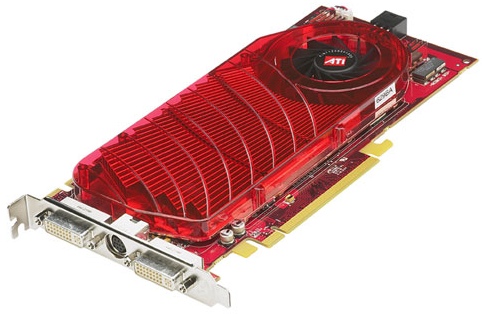
With a sub-$200 price tag, the GeForce 7900GS has indeed made a great job filling the gap, in fact, prior to the release of the competing Radeon X1950 Pro, there was nothing that could really compete with it in this price range. Therefore in an effort to regain some prime real-estate back, ATI gave life to this new Radeon family member.
Like the 7900GS, the X1950 Pro appears to be a brand new product, and it even goes by a new code-name “RV570”, but do not let this fool you. The specifications of the X1950 Pro are suspiciously close to that of the X1900GT, which was a failure in my eyes. Perhaps that's a little harsh comment regarding the Radeon X1900GT, however at the time of its release the product was slower than existing X1800XT and 7900GT products, yet it was significantly more expensive. For that reason I wrote the X1900GT off early, and it never really came back to redeem itself, until now of course. The new X1950 Pro features the same core clock frequency as the X1900GT, faster memory (180MHz higher) and the same amount of rendering pipelines. However, while the X1900GT made its debut at $300, the X1950 Pro will be available at the much more affordable price of $200. Although on paper the specifications of the X1950 Pro and 7900GS seem to be quite different, there are a few similarities we can talk about. For starters, both products come armed with 256MB GDDR3 memory, though the X1950 Pro has a 60MHz clock advantage here. As usual, the ATI card also carries the higher core clock frequency (125MHz advantage). However, where the X1950 Pro loses is in the amount of physical pipelines as it features just 12, whereas the 7900GS sports a total of 20. Both graphics cards feature a single texture mapping unit, and the X1950 Pro utilizes an additional vertex processing unit. Once all that has been taken into account, the X1950 Pro ends up with just 2GB/s more memory bandwidth on its favor (a ~5% advantage).
Perhaps, the biggest strength of the GeForce 7900GS is its overclocking ability. Manufacturers are already shipping 7900GS cards with a 30% rise in core frequencies and up to 10% boost in memory speeds. In many cases I found this to result in performance increases that went anywhere from 15% and up to 30%. Given the 7900GS already delivers exceptionally good value for a sub-$200 graphics card, a potential performance increase of 30% is very impressive.
This is where I believe the war between the GeForce 7900GS and the Radeon X1950 Pro will be settled. Depending on the games used for comparison, the performance can go either way as we have seen time and time again. This means that unless the Radeon X1950 Pro is able to achieve a reasonable boost in performance through overclocking, it might fall short, or will it?
Benchmarks: 3Dmark2006, X3: Reunion
- Intel Core 2 Duo E6700 (2.66GHz) LGA775
- ATI Radeon X1950 Pro (256MB)
- Microsoft Windows XP Pro (SP2)
- Nvidia Forceware 91.47
- ATI Catalyst 6.10
- Intel System Drivers 7.2.2


Previous tests using X3: Reunion have shown that this engine tends to favor ATI-based graphics cards. That being the case I was not surprised to find the Radeon X1950 Pro defeating the GeForce 7900GS. However, I was surprised about the degree to which the X1950 Pro defeated the 7900GS, at 1600x1200 the Radeon was 40% more powerful. The X1950 Pro once again failed to gain much ground through overclocking, and as a result the 7900GS was able to close the margin down to 22%.
Benchmarks: Far Cry, F.E.A.R

 The Radeon X1950 Pro also does very well in Far Cry as it defeated the GeForce 7900GS by 40% prior to overclocking. Once the cards were overclocked this margin was reduced to 24%, which is still obviously a very significant win for the X1950 Pro.

 F.E.A.R is a very demanding game, and when FSAA 4x + Aniso 16x quality settings are enabled, good frame rates are hard to come by. That being the case we will go off the 1024x768 performance where the Radeon X1950 Pro was 45% faster than the GeForce 7900GS. Once again overclocking did reduce the performance margin to 26% in favor of the Radeon, still a very strong lead.
And the best buy is: The overclocked GeForce 7900GS configuration did its best to hang in there, and at the lowest tested resolution of 1024x768 it did quite well against the X1950 Pro. As the resolution was increased, so did the performance gap, and by the time we hit 1600x1200 the X1950 Pro was leading the pack. Just a month ago we found ourselves testing the 7900GS as the new king in the $200 price bracket as it bridged the performance gap between the 7900GT and the budget performance king the 7600GT. Only a month later, the 7900GS has been knocked from its perch by the Radeon X1950 Pro which has now established itself as the most dominant $200 graphics card on the market. Now ATI just needs to get the X1950 Pro out there in numbers, and I am sure this is what will happen in the coming weeks.


Coke or Pepsi? Intel or AMD or in this case ATI or NVIDIA? It’s all about choices. Like always, the competition is fierce between the Santa Clara based NVIDIA and the red team from Ontario. This time it’s NVIDIA’s turn, they just released their GeForce 8800 series, signifying, you guessed it, another speed increase. Though, I’m left wondering what they are going to do after the 9xxx numbers are used. NVIDIA has come a long way from the old GeForce FX 5800 “Dustbuster” days, remember that one?
The GeForce 8800 series is getting a lot of attention due to its lead over ATI in many graphics benchmarks, in some cases beating ATI's cards in a Crossfire setup. But as usual, you don't get to keep the performance crown that long in the graphics world, as either ATI or NVIDIA are always cooking up something to dethrone the other.
The GeForce 8800 series codenamed G80 is DirectX 10 compliant and comes in two flavors: GeForce 8800GTX and 8800GTS.
The 8800 GTX card has all architectural features enabled, including the128 stream processors running at 1.35GHz, the GPU clocking in at 575MHz and a 384-bit path to memory. The amount of built-in memory is an amazing (for graphics cards at least), 768MB of Samsung GDDR3 clocked at 900MHz (1800MHz effective being DDR). This card will be priced at $599, but you can expect higher prices then the suggested MSRP. For those of us with less money to burn, NVIDIA also created the 8800 GTS variant featuring a 500MHz GPU, 1.2GHz stream processors, 640MB of GDDR3 memory running at 800MHz, and the same set of output ports and capabilities as the GTX. The GTS is basically uses a cut-down version of the G80 with some units disabled, equipped with 96 stream processors, five ROP partitions, and a 320-bit memory path. All these lesser capabilities can be seen in the lower price of $449.
The GTS variant might offer lesser performance but it offers something that GTX can’t: a shorter board and less power-hungry. The GTX will actually need dual six-pin PCIe power connectors not to mention that it looks absolutely huge!!!
A new graphics card from NVIDIA also signifies getting a new mascot. It started with the now famous Dawn demo and it continued with Nalu the mermaid and the high priestess Luna. With the 8800 series they are now using Adrianne Curry, a real-life model. The previous tech demos used fictional characters.
The Architecture
NVIDIA played it safe with this design by using the tried and true 90nm process; this allows for increased yields, but on the other hand a very large chip.
The G80 architecture that the 8800 series is based on uses a unified architecture that merges both vertex and pixel shaders into a single tank of floating-point processors.
On the simplified diagram of the G80 the green squares the Stream processors; the G80 has a total of 128 on the GTS version. Unlike in traditional architectures the stream processors aren't vertex or pixel shaders, but generalized floating-point processors capable of operating on vertices, pixels, or any type of data that it gets thrown at it. These Stream Processors operate at an astonishing 1.35GHz.
Below the Stream Processors we find the ROP partitions with their L2 cache. These ROP partitions have in total a 384-bit path to memory. Also noteworthy is the fact that NVIDIA chose a separate chip to drive displays
I also expect a slew of lower priced midrange and low-end cards based on this architecture to appear soon

As you can see in the picture above, the board is your typical ATI Radeon X1900 with the old and loud cooler, but now with AMD branding. We know that the colour of upcoming graphics products is still red, so perhaps AMD won't bring Graphzilla's colour to the PCB level. The board is only a rebranding of never released FireSTREAM boards, which were ready for launch in late September, but AMD wanted to do the rebranding thing first.
The "Stream Processor" comes running at a clockspeed similar to that used on X1900XT series of cards. The board packs 1GB of GDDR3 memory - 512MB located at the front and 512MB at the back of the PCB.
On two pictures below, you can see how the "ATI FireSTREAM Enterprise Stream Processor" originally looked:

Since Nvidia already uses the term "Stream Processor" as a description for its scalar Shader units, we're tempted to suggest that AMD's marketing might have missed the boat.
We can now conclude that the acquisition is over and that the ATI brand is dead after all, as we wrote over three months ago.
AMD decided to do an Nvidia/3dfx and the case is closed. Regardless of what some AMD or ATI execs might be saying, the actions they took with their partners and employees of ATI speak for themselves.
We have heard that even the Radeon brand is in jeopardy, because some AMD folk are constantly downplaying the value of ATI and related brands. But we will be addressing this and disclosing all of the nitty and gritty next week. µ
The Bethesda Softworks title also picked up the game of the year prize for both the PC and Xbox.
Oblivion fought off competition from the likes of Call of Duty 2, Resident Evil 4, Guitar Hero, Grand Theft Auto: Liberty City Stories and Pro Evolution Soccer 5 to scoop the ultimate game accolade.
The honour for the best online game of the year went to Age of Empires III, while Grand Theft Auto: Liberty City Stories took home the online handheld game of year prize.
This year's awards, held at London's Park Lane Hilton hotel, were voted for by more than 500,000 readers of computer and video games magazines.
Resident Evil 4 picked up the PlayStation game of the year award and New Super Mario Bros was crowned Nintendo game of the year.
Sony's highly anticipated PlayStation 3, which is set for release in the US in November, scooped the one to watch for 2007 award.
US-based Electronic Arts was named publisher of the year and Game was named top retailer.
Other winners on the night included Nintendogs for girls' choice and family game.
The coveted Golden Joystick Awards were first held back in 1982, when Atari, Commodore and Spectrum ruled the market and Sony were still best known for the Walkman.
This year, for the first time ever, the awards were webcast on the Computer and Video Games website.
Event organiser James Ashton-Tyler said: "It's great to see that gamers have rewarded Elder Scrolls IV with three awards. The game represents a genuine advance for the role-playing genre both in its structure and presentation. Its success at this year's Joysticks is just reward for the talented team responsible for its creation.
"The Golden Joystick Awards are the only way UK gamers can directly tell games publishers which games made their year. With a record number of votes cast in 2006, the Golden Joystick Awards have cemented their position as a benchmark for the industry. Winning an award chosen by expert gamers is the ultimate accolade."
The video game sector is a $10bn industry in the US and more than 90 per cent of all American children and teenagers play video games, on average for about 30 minutes daily.
The winners of the 2006 Golden Joystick Awards in full are as follows:
Ultimate Game of the Year - Elder Scrolls IV: Oblivion
Editor's Game of the Year - Ghost Recon: Advanced Warfighter
Family Game Award - Nintendogs
Girls Choice Award - Nintendogs
All-Nighter Award - Pro Evolution Soccer 5
PlayStation 2 Game of the Year - Resident Evil 4
Nintendo Game of the Year - New Super Mario Brothers
Xbox Game of the Year - Elder Scrolls IV: Oblivion
PC Game of the Year - Elder Scrolls IV: Oblivion
Handheld Game of the Year - GTA: Liberty City Stories
Online Game of the Year - Age of Empires III
Soundtrack of the Year - Need for Speed: Most Wanted
Innovation Award - Xbox Live Marketplace
The One to Watch for 2007 - Sony PlayStation 3
Favourite Character Award - Lara Croft
Publisher of the Year - Electronic Arts
Retailer of the Year - Game

The latest entry in the budget video card space comes in the form of the ATI Radeon X1650 XT. Designed to supplant the Radeon X1600 XT in ATI's product lineup, the X1650 XT appears to be targeted at the popular NVIDIA GeForce 7600XT.
ATI's newest card uses the RV560 GPU, which is almost identical to the RV570 powering the X1950 Pro, but has some of the RV570's functionality disabled. The X1650 XT sports 24 pixel shaders, eight vertex shaders, and eight texture units. Clock speed on the GPU is set at 575MHz with the 256MB of GDDR3 running at 675MHz. The data path between GPU and GDDR3 is only 128-bit, compared to the 256-bit path on the X1950 Pro.
The Radeon X1650 XT does CrossFire, and ATI has indicated that they will eventually support for three- and even four-card CrossFire configurations down the line.
As is the case with any video card launch, there are a bunch of reviews of the card available with detailed benchmarks on popular gaming titles. In summary, performance is about what one would expect from a $149 video card. As an illustration, The Tech Report's tests using Half-Life 2: Episode One showed that the X1650XT held its own against the 7600GT, hitting 51.2fps at 1280x1024 in a single-card setup and 93.9fps in a CrossFire configuration. Having said that, the X1650 XT was near the bottom of the tested video cards in the HL2 shootout.
When it comes to power and noise, the X1650 XT is a mixed bag. According to The Tech Reports's measurements, the X1650 XT consumes 148W when idle and maxed out at 209W. Both figures were in the lower third of the cards evaluated. Noise-wise, the X1650XT was near the top when idle, at 44.1 decibels. The only louder cards in a single-card configuration were the X1900XT, X1900 XTX, and GeForce 7900GT. It was much better under load, the the noise level only increasing to 46.3 decibels.
At $149, the Radeon X1650 XT is a decent performer. However, discerning gamers will likely be best servyed by spending another $50 to get a significantly better video card like the Radeon X1950 Pro or the NVIDIA GeForce 7900 GS.
ATI says that the Radeon X1650 XT will be available in stores on November 13.
Some gaming screenshots.


It was bound to happen, but a number of our readers have recently sent in e-mails asking what graphics cards would be best for rendering graphics in adult video games. With the adult industry quickly growing its obvious why 3D sex technology is starting to take off. ThriXXX Technology is one of the leaders in realtime 3D rendering for adult ‘game’ titles and has produced a number of game titles in this genera over the years. ThriXXX is also the software behind porn mega star Jenna Jameson’s latest online venture – Virtually Jenna. Virtually Jenna is the official video game of Jenna Jameson and since it uses the popular ThriXXX graphics engine to render it we figured this would be the best combination to test out ATI and NVIDIA graphics cards to see who is best when it comes to adult gaming performance.
Since testing graphics cards on adult video games is something unheard of it wasn't surprising to not find a single ThriXXX game title listed on NVIDIA's SLI optimized game list even though it has 350 games that are SLI optimized. To be fair ATI doesn't list any adult titles for their CrossFire platforms either. It seems that those that play adult game titles really have no clue of what works and what doesn't, so it makes sense why we got those e-mails.
After looking into the game Virtual Jenna it was found that the system requirements seemed pretty easy as the game requirements state that it needs at least an Intel Pentium 4 processor and 256MB of system memory and a 3D graphics card that has at least 64MB of memory on board.

We’ve been very impressed with Ati’s high end cards over recent months but there’s been a gaping hole in its product line in the $250 mark for some time: Nvidia’s 7600-series cards have proven to be the best price-performance combination. Ati’s X1600 series just couldn’t compete.
The X1650 Pro is another increment in what’s becoming an increasingly fragmented and confusing series. To make matters worse the X1650 Pro is available in two flavours: one with GDDR2 memory and the other (like this one) with GDDR3. Both flavours have 256MB of 128-bit memory.
The original X1600 XT was poor and GeCube’s X1650 Pro is not a massive upgrade. The core clock speed has been boosted 10Mhz to 600Mhz and the memory clock has increased to 740MHz. There are still 5 vertex shaders and 12 pixel shaders.
In our medium (1280 x 1024) tests it averaged 21fps in Far Cry and 23fps in Call of Duty 2. In other words it made no difference to Far Cry over an X1600 XT and provided a 5fps boost in CoD2. None of these scores are playable.

The fan is an unobtrusive whoosh and GeCube bundles no software: keeping the price down. Ati believes this card will rival Nvidia’s 7600 GS but it’s $50 more expensive (with similar performance). Nvidia’s 7600 GT is significantly more powerful and $40 cheaper. However, if you want to stick with Ati for the excellent AVIVO features, video transcoding and ability to use HDR and antialiasing at the same time, we recommend choosing an X1800 GTO. These now cost just $30 more and play all games at 1280 x 1024. Ati’s aggressive price drops have returned to bite it in the bottom.
The X1650 Pro is another increment in what’s becoming an increasingly fragmented and confusing series. To make matters worse the X1650 Pro is available in two flavours: one with GDDR2 memory and the other (like this one) with GDDR3. Both flavours have 256MB of 128-bit memory.
The original X1600 XT was poor and GeCube’s X1650 Pro is not a massive upgrade. The core clock speed has been boosted 10Mhz to 600Mhz and the memory clock has increased to 740MHz. There are still 5 vertex shaders and 12 pixel shaders.
In our medium (1280 x 1024) tests it averaged 21fps in Far Cry and 23fps in Call of Duty 2. In other words it made no difference to Far Cry over an X1600 XT and provided a 5fps boost in CoD2. None of these scores are playable.
The fan is an unobtrusive whoosh and GeCube bundles no software: keeping the price down. Ati believes this card will rival Nvidia’s 7600 GS but it’s $50 more expensive (with similar performance). Nvidia’s 7600 GT is significantly more powerful and $40 cheaper. However, if you want to stick with Ati for the excellent AVIVO features, video transcoding and ability to use HDR and antialiasing at the same time, we recommend choosing an X1800 GTO. These now cost just $30 more and play all games at 1280 x 1024. Ati’s aggressive price drops have returned to bite it in the bottom.

ATI Technologies has launched its mid-range Radeon X1950 Pro graphics card.
The company says that the Radeon X1950 Pro is the first graphics card to make use of new native CrossFire technology, simplifying the multi-GPU experience by eliminating the need for a branded CrossFire Edition card.
The Radeon X1950 Pro is also ATI's first 80nm graphics core, and features 36 pixel shaders, 8 vertex shaders, and 12 texture processing units.
In a statement, Rick Bergman, senior vice president and general manager at PC Business, ATI Technologies, said, "The Radeon X1950 Pro has an incredibly good value, which shows that ATI is taking gamers feedback to heart with the introduction of new native CrossFire technology to make it easier than ever for gamers to get up and get running with a CrossFire set-up."
The Radeon X1950 Pro offers the same image quality as ATI's flagship Radeon X1950 XTX, including the ability to enable FP16 High Dynamic Range effects with anti-aliasing at the same time.
The graphics card provides exceptional video quality while playing today's high-definition media formats, displaying one billion colors, or 10-bit throughout the graphics pipeline. The new card is also HDCP-compliant, including a built-in EEPROM and HDCP key. In addition, the card is ready for Windows Vista.
The Radeon X1950 Pro is shipping at an estimated street price (ESP) of $199 (Rs 9,154).
Nvidia Corp., a leading supplier of graphics technologies, has announced a new graphics processing unit (GPU) for mobile computers. The new chip targets systems designed for gamers that are mostly desktop replacement type of laptops and are hardly tailored for use on the go. Nevertheless, the launch increases the gap between performance offered by ATI and Nvidia in the mobile graphics space.
The GeForce Go 7950 GTX has 24 pixel processors, 8 vertex processors and is clocked at 575MHz, up 75MHz compared to the predecessor, the GeForce Go 7900 GTX. Nvidia recommends to use 512MB of 1400MHz GDDR3 memory with 256-bit along with the new mobile graphics chip, which is another 200MHz improvement over the previous high-end graphics part.
Even though the market of high-performance mobile computers for gamers is relatively small, it is highly profitable and Nvidia enjoys the lead over ATI Technologies here. Currently the fastest mobile graphics chip the Markham, Ontario-based developer can offer is Mobility Radeon X1800 XT, which has 16 pixel processors, 8 vertex processor and 550MHz clock-speed. Technical specs of the GeForce Go 7950 GTX are close to those of pre-overclocked GeForce 7900 GT graphics boards for desktops, which usually either deliver equal performance with desktop Radeon X1800 XT (625MHz core-clock), or outperform the rival tangibly.
“2006 is a phenomenal year of growth and technology leadership for Nvidia notebook GPUs. The efficient Nvidia GeForce 7-series GPU architecture continues to deliver the ultimate visual experience in notebooks of every class – from lightweight ultra-portables to HD DVD multimedia machines,” said Jeff Fisher, senior vice president of the GPU business unit at Nvidia.
The GeForce Go 7950 GTX graphics processor is produced using 90nm process technology and has power envelope of 45W. To preserve energy, the chip supports PowerMizer 6.0 technology as well as some other features.
Notebooks featuring the Nvidia GeForce Go 7950 GTX GPU are available for order from notebook suppliers in North America and
PCMagazine says the NVIDIA GeoForce Go 7950 GTZ is the world's fastest mobile graphics processing unit (GPU), supporting games and applications for DirectX 9.0, Shader Model 3.0, and high dymanic range (HDR) lighting.
"2006 is a phenomenal year of growth and technology leadership for NVIDIA notebook GPUs. The efficient NVIDIA GeForce 7 series GPU architecture continues to deliver the ultimate visual experience in notebooks of every class—from lightweight ultra-portables to HD DVD multimedia machines," says Jeff Fisher, Senior Vice President of the GPU Business Unit at NVIDIA. "Notebooks based on our flagship GeForce Go 7950 GTX GPU will deliver the premiere visceral experience for gamers."
"Dell is fully committed to delivering the most intensely realistic gaming and entertainment experience to PC gamers," said Brett Faulk, director of Inspiron and mobile XPS product marketing. "Dell XPS notebooks have swept the awards thanks to their sheer gaming performance and the Dell XPS M1710 with GeForce Go 7950 GTX is our best yet."
Among those planned to introduce new laptops featuring the NVIDIA GeForce Go 7950 GTX graphics adapter are Dell, Sager, ABS, Falcon Northwest, Hypersonic, ProStar, and Voodoo PC.
This past week, 99.7 percent of ATI stockholders voted in favor of AMD’s acquisition of ATI. There was almost no question for these stockholders that aligning themselves with the fastest growing chip company and number two worldwide supplier of microprocessors would be beneficial for the GPU company. With the ability to pair ATI’s already advanced graphics processing units with AMD’s efficient, fast, and energy-saving microprocessors, and with the further gains from integrating the two systems together, the acquisition should turn out quite well for both companies involved.
But if NVIDIA stockholders were given the ability to vote at the ATI shareholder meeting mentioned earlier, they would have voted even more overwhelmingly in favor of the acquisition. In fact, since AMD announced it would attempt a friendly takeover of ATI in July of this year, NVIDIA’s shares stopped plummeting and have since grown over 73 percent.
 NVIDIA’s shares from May-Present. Notice how stock prices, which were quickly decreasing, took a turn for the better right around the time of the AMD and ATI merger announcement. Image courtesy of MSN|Money |
This result may sound counterintuitive at first. In fact, one may think that the pairing of ATI and AMD would create a juggernaut, an incredible foe that NVIDIA would have to wrestle with. This would most likely have the opposite effect on NVIDIA shares, driving them down in value, instead of straight up through the roof.
Some might argue that this stock price jump resulted from shareholder expectations that Intel, AMD’s largest rival, will soon purchase NVIDIA. This doesn’t make much sense, however, for two reasons. First, Intel is a sinking ship, and no NVIDIA shareholder wants to sink with it. Second, Intel already devotes thousands of its employees to graphics processors (however inferior some believe they are), and so the overlap of resources by acquiring NVIDIA would be wasteful.
Upon careful examination of the results of the merger, however, the opposite becomes clear: ATI is using this as an opportunity to step out of the high-end market and into the general consumer market. With 3DLabs already bowing out of the high-end 3D GPU industry, this leaves NVIDIA the only company that will be supplying top-notch graphics processors to the DCC industry.
This becomes all the clearer once you consider AMD’s goals and the announcements at the most recent ATI shareholder meeting. AMD’s slogan is “50 by 15”, a reference to the fact that they want 50 percent of the world’s population to own computers by 2015 (presumably with AMD processors in them). ATI’s President and CEO, David Orton, echoed this sentiment at the latest ATI stockholder meeting, saying he believed that they can make available $100 personal computers “before 2010”.
The kinds of computers that will cost $100 and will be available to a half of the global population will most definitely not be the kinds of computers that one could use a serious 3D modeling program on, let alone render a scene (in under a week). Although AMD’s goals are laudable, they also mean that a powerful 3D GPU company, ATI, has just stepped out of the running for producing graphics processors for our use.
No wonder NVIDIA shareholders were excited; now they are the unparalleled dominators of the high-paying high-end market.
Whether or not this is a cheerful outcome for the DCC industry as a whole remains to be seen. Usually when there’s only one unchallenged ruler of an industry (NVIDIA), the results are bad for consumers (us), because the ruler can charge incredibly high prices and produce otherwise inferior goods, because, after all, who are the consumers going to turn to instead?
At the same time, NVIDIA may try to keep at the cutting edge of quality and price in order to deter potential future challengers, and to ensure it gets repeat business from all of us. I certainly hope it chooses the latter option, since it looks like I will be buying quite a few NVIDIA cards well into the future.




